

A color consultation is a walkthrough where your painter studies the light and the surroundings, then brushes real paint samples onto your own surfaces so you can judge the color where it will actually live. It happens before any paint is ordered. The point is not to push a trendy shade. The point is to make sure the color you commit to still looks right at eight in the morning, at noon, and at dusk.
Here's the short version:
- Color reads differently on a store chip, a phone screen, and a wall, so sampling on the real surface is the only honest test.
- The walkthrough starts with the things that are not changing, including the light each wall gets and the colors already around the house.
- Coastal light in Huntington Beach is bright and often filtered through marine layer gray, which pushes whites and grays around more than people expect.
- Sharp's Painting includes the color consultation with the free estimate and brushes up to 10 free samples on your walls.
Why Color Is the Hardest Part of a Paint Project
Most homeowners decide the rest quickly. Sheen, schedule, which rooms, whether the trim gets done. Color is where projects stall, because color is the one decision that is expensive to undo. Prep can be inspected. Lines can be judged up close. But a color that feels cold, or reads green when you wanted gray, only shows itself once the room is finished and the furniture goes back.
Part of the difficulty is that paint color is not a fixed property. It is a reaction between pigment, light, and everything nearby that bounces light back onto the wall. A beige that looks warm under store lighting can look pink next to warm toned surfaces outside. A soft white can look blue in a north facing room on a gray morning. None of that is a flaw in the paint. It is the surroundings doing what surroundings do.
What Gets Looked At First
Before colors come up at all, the walkthrough is mostly observation.
Light and orientation
Which way does the wall face, and when does direct sun hit it. South and west facing walls take strong afternoon light that washes color out and makes mid tones read lighter. North facing rooms stay cooler and can pull a neutral toward blue. A room with one small window behaves nothing like a room with sliders across a whole wall.
Colors that are staying
Flooring, countertops, cabinet fronts you are keeping, and window frames. Those colors set the undertone your wall color has to live beside. If the floor has a yellow cast, a cool gray will fight it.
Architecture and texture
Trim profiles, crown molding, how much millwork a room has, and whether a wall is smooth or heavily textured. A house with deep trim can carry more contrast than one with simple square casing, and texture creates small shadows that change how a color reads. On stucco, the depth of the existing texture matters as much as the color, which is part of why Stucco Painting and Repair and color choices get discussed in the same visit.
Sample colors brushed directly onto a stucco wall so they can be judged in natural daylight.
Interior Consultations, Room by Room
Inside, the work is partly about single rooms and partly about how rooms connect. Open floor plans mean you see three colors at once from the kitchen. Hallways carry color from one space into another. A shade that works in a closed guest room can feel abrupt where it meets a living room you see from the front door.
The walkthrough covers the furniture and rugs you plan to keep, the main windows, and where your eye lands when you walk in. Trim and ceilings get settled at the same time, since the break between wall and trim is what makes a color look intentional. Sheen belongs in the conversation too, because the same color in flat and in satin will not read the same. There is a fuller breakdown of that in Interior Paint Sheens Explained, Room by Room.
This is also the moment to decide whether one wall should do something different. Accent Wall Painting can change a room without repainting all four sides, but it only works when the color is tested against the furniture already in the space.
Exterior Consultations, and Everything Around the House
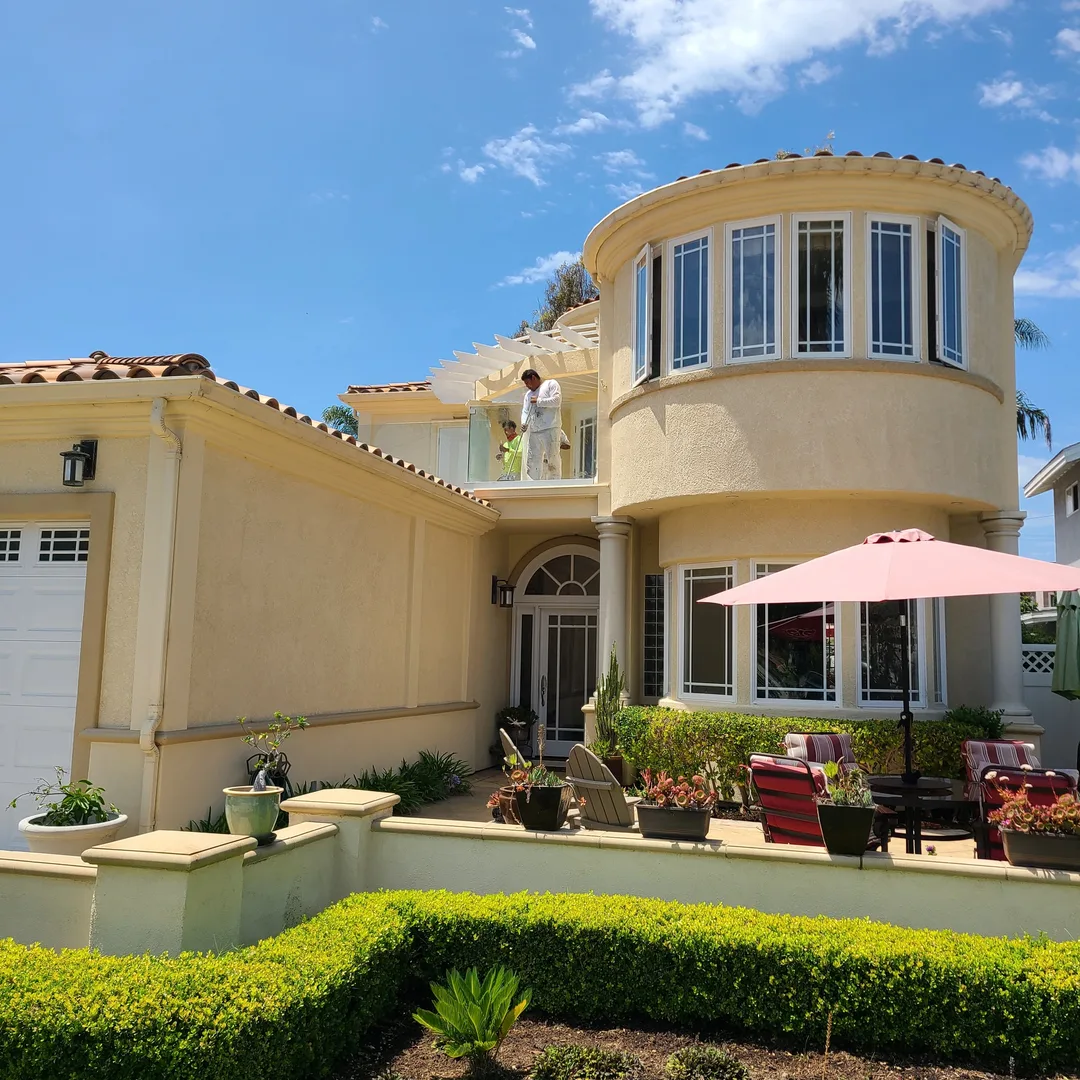
Outside, the house is never seen alone. An exterior walkthrough takes in the stucco or siding, the trim and fascia, the garage door, the fencing and gates, and the houses on either side. Homeowners often pick a body color in isolation and then find it does not sit well next to the surfaces around it that are not being changed.
Coastal light adds its own complication. Bright sun off light stucco creates glare that flattens detail, while the morning marine layer drops a gray cast over everything and makes cool colors read colder. That is why whites are harder here than almost anywhere. The subject gets its own treatment in Choosing the Right White for a Coastal Exterior, and it is worth reading before you settle on one. If your neighborhood has an approved palette, that gets factored in early so you are not choosing twice.
Chips, Screens, and Walls Are Three Different Things
| Where you see the color | What it does to your judgment |
|---|---|
| Paper chip in a store | Lit by overhead store lighting, viewed at postage stamp size, surrounded by competing colors |
| Phone or computer screen | Backlit and adjusted by the display, so saturation and warmth are not reliable |
| Small card held to a wall | Too small to overcome the color already on the wall behind it |
| Brushed sample on your surface | Shows the real color, in real light, on the real texture it will sit on |
A useful sample is generous in size, and you look at it more than once. Brush a large patch, then come back in the morning, in the middle of the day, and in the evening with the lamps on. Put two candidates side by side, because color is easier to judge in comparison than alone. On exteriors, check samples on more than one wall. The same body color can look like two colors on a sun drenched west side and a shaded north side, and the test that matters is the view from the curb.
Coordinating Body, Trim, and Accent
Three decisions have to work together. The body color covers the most area and sets the tone. Trim provides contrast and defines edges. The accent, usually the front door, is where a little personality belongs. Trouble shows up when all three are picked separately. A trim white cooler than the body can make the body look muddy, and a garage door that is a near miss on the body color looks like a mistake instead of a choice.
The regrets a consultation prevents are predictable. A gray that turns blue or purple in coastal light. A body color that clashes with surfaces that are staying. A dark shade on a wall that takes full afternoon sun. One safe neutral through a whole interior that reads flat in the rooms with the least daylight.
How Sharp's Painting Builds Color Help Into Every Project
At Sharp's Painting, the color consultation is part of the free estimate on residential and commercial work alike. There is no separate charge for the advice. Robert Sharp walks the rooms or the exterior with you, brings up to 10 free samples, and brushes them onto your own stucco, siding, trim, or walls so you can judge them in your own light before anything is ordered.
We have painted in Huntington Beach and across coastal Orange County for over 27 years, so we know how the marine layer and the afternoon glare treat a color here. Robert runs his own crew with no subcontractors and is on site daily, which means the person who helped you choose the color is the person watching it go on. The same color help carries through whether the job is an interior repaint, an exterior, or a whole house under Residential Painting, and our Color Consultation Services page covers the walkthrough in more detail.
You pay nothing until the work is done and you are satisfied. To set up a walkthrough, request a free estimate and color consultation or call (714) 610-5880.
FAQs
Does the color consultation cost anything?
No. The color help is included as part of the free estimate, so you can settle on the right shade without paying for the advice. That applies to residential and commercial projects alike.
Can I see a color on my actual wall before you paint?
Yes. Robert brushes real samples onto your walls so you see how each color looks in your own light before anything is ordered or the work begins. Up to 10 free samples are included.
How many colors should I be deciding between?
Fewer than you think. Narrowing to two or three candidates before sampling makes the comparison much easier, since side by side is how people judge color best. Robert will help you cut the list down during the walkthrough.
Why do grays and whites look so different here than inland?
Coastal light is the reason. Strong sun off light surfaces creates glare that flattens color, and the morning marine layer lays a gray cast over everything, which pulls cool colors colder. Testing on your own walls at different hours is the only reliable way to see it.
Do you help with trim and ceiling colors, not just the walls?
Yes. Trim, baseboards, crown molding, ceilings, doors, and accents all get settled in the same walkthrough, because they only look right when they are chosen together with the body color.